Daylight
The strongest light source we have. Even on an overcast day, there is many times more light outdoors than indoors. Artificial lighting complements it; it does not replace it.
 EXPERIENCE

Healthy Living

Healthy Living & Smart Home
Dynamic lighting and intelligent home control, designed so that you don’t have to think about them.
Illustrative visualisation
A home that understands your life
The best technology is the kind you don’t have to operate all the time.
No searching for switches, no readjusting the thermostat, no evening round to check whether a light has been left on. The house knows the time of day, recognises where you are and prepares the environment before you even think of it. You always have the final say.
In the morning, the light brightens by itself, without glare.
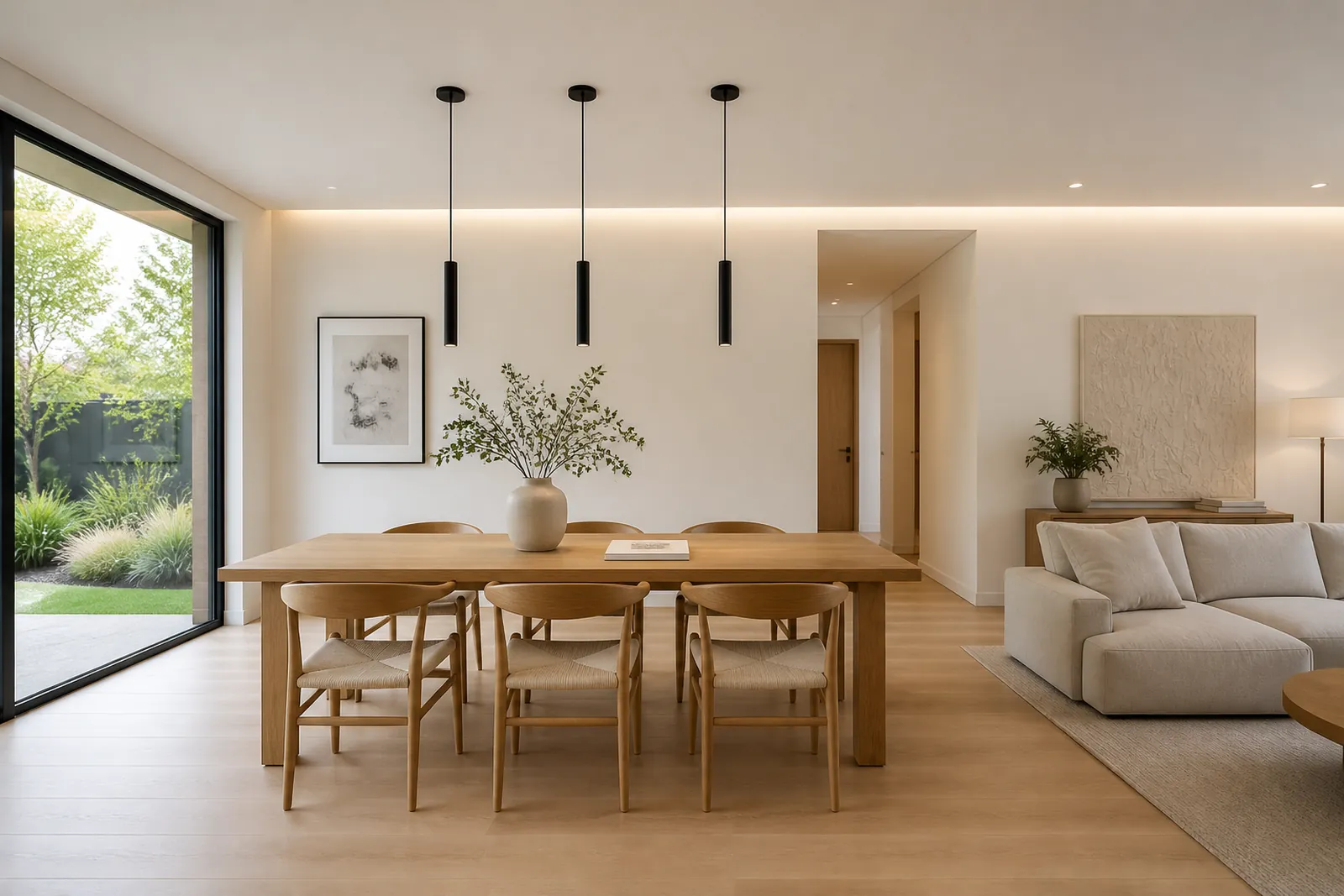
During the day, bright neutral light where daylight is not enough.
The blinds provide shade before the room overheats.
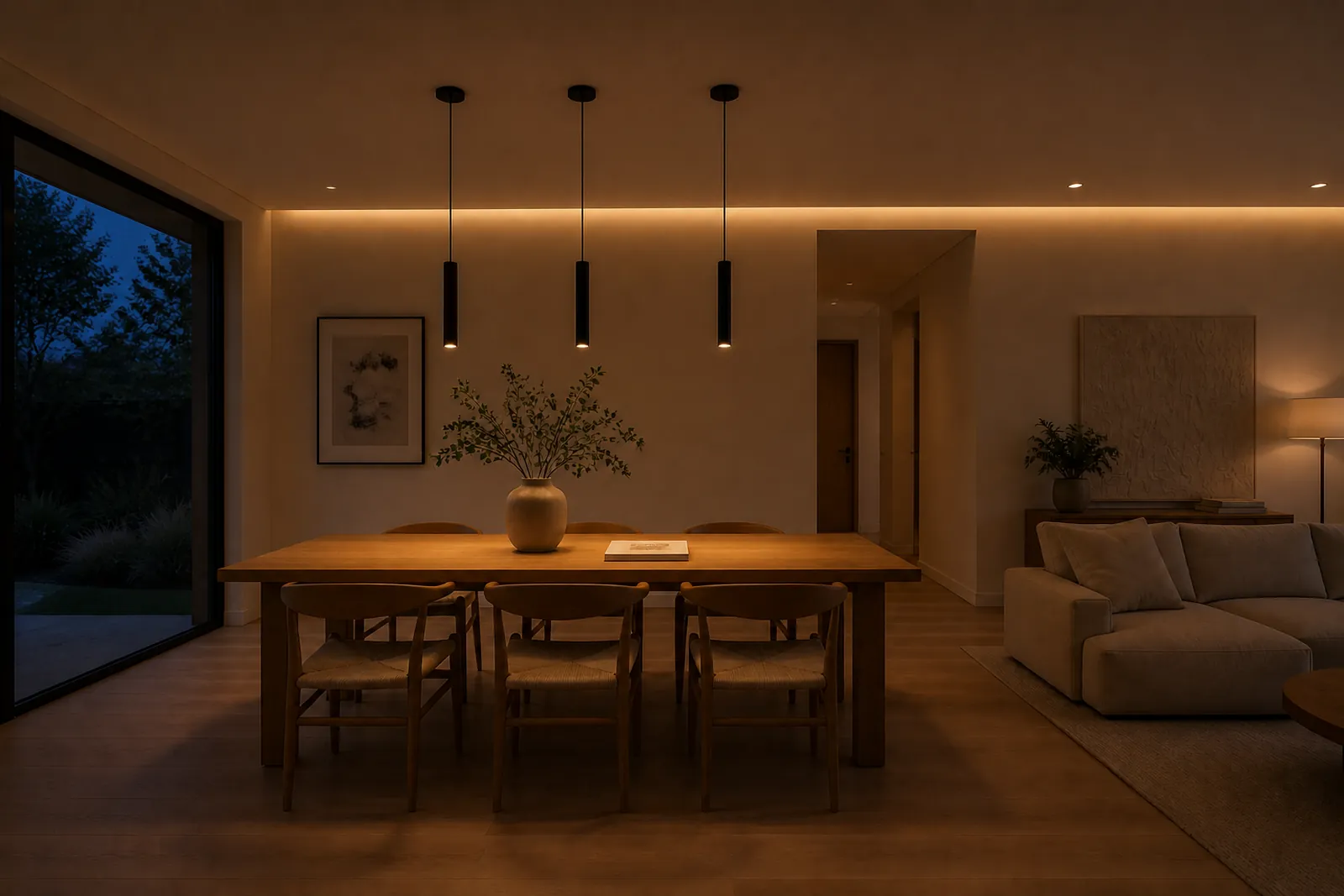
In the evening, warm and dimmed light.
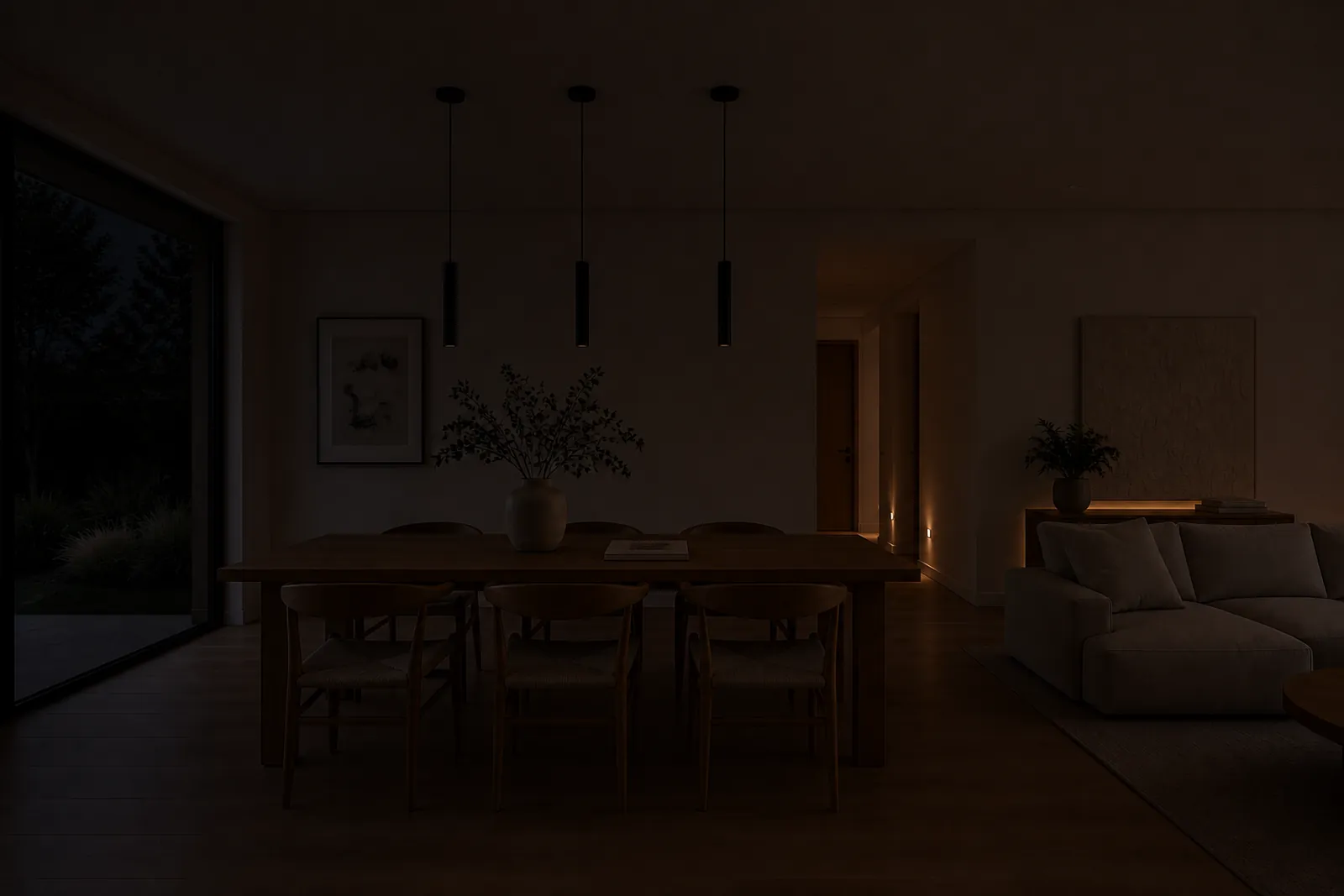
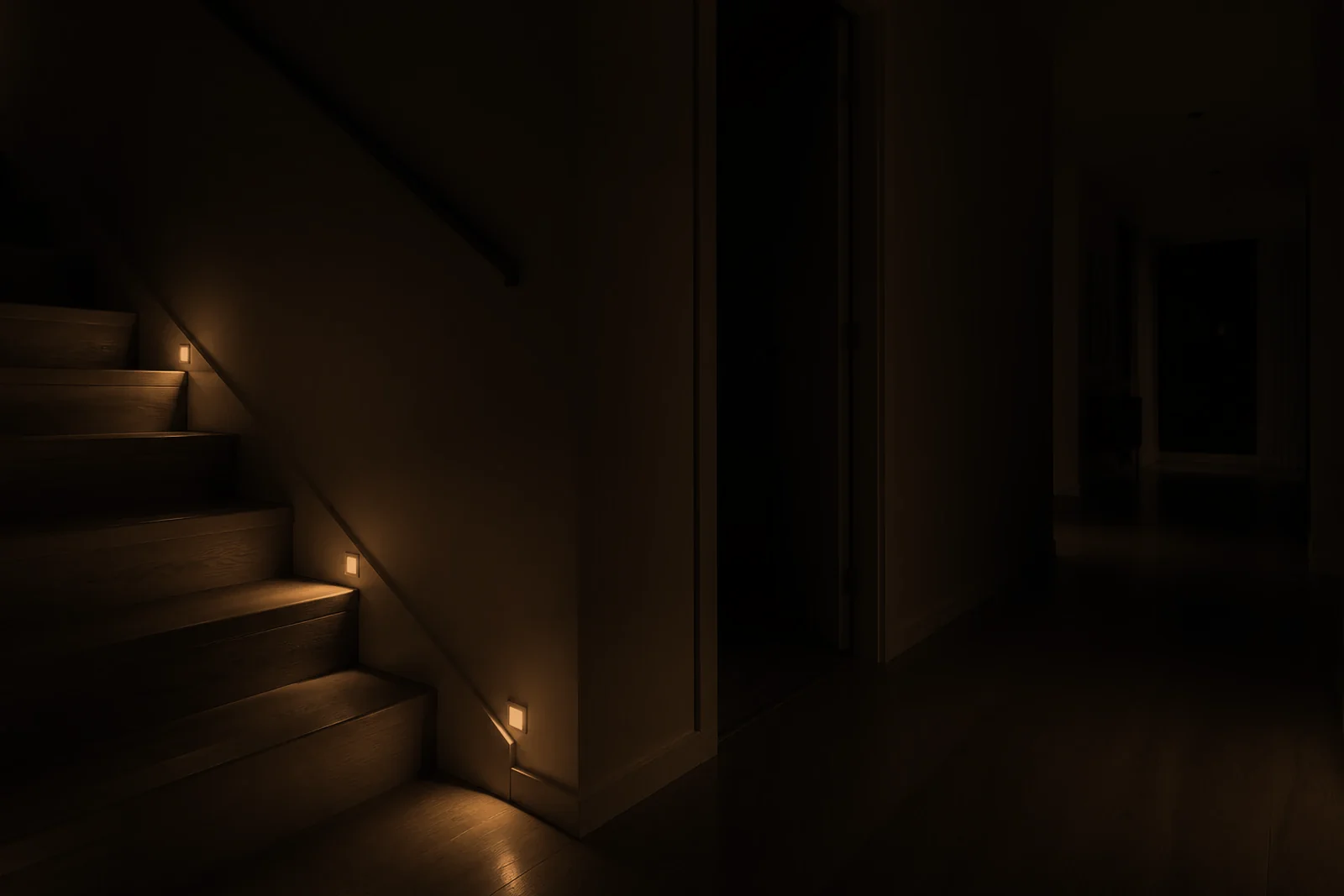
At night, only gentle orientation light near the floor.
Why lighting quality matters
Through the eyes, light helps regulate the body’s internal clock: when we feel alert and when the body starts preparing for sleep. Four factors matter.
The strongest light source we have. Even on an overcast day, there is many times more light outdoors than indoors. Artificial lighting complements it; it does not replace it.
What matters is how much light actually reaches the eyes, not how much falls on the table. More during the day, much less in the evening.
Correlated colour temperature (CCT, in kelvin) describes only the colour appearance of light. The biological effect depends on the entire spectrum. Changing the CCT alone is therefore not enough.
The same light has a different effect in the morning than late in the evening. In the evening, the key is to reduce the light.
International expert recommendations advise sufficient light at eye level during the day, significantly less light in the evening from about three hours before bedtime, and darkness at night.1, 2 Good-quality light also means faithful colours (CRI ≥ 90), no visible flicker and no glare.
How strongly this affects an individual. Sensitivity to light varies considerably from person to person, and screens, daily routines and access to daylight also play a role.3, 4 Dynamic lighting is neither a treatment nor a guarantee of better sleep. It is a tool that makes it easier to establish a clear difference between day and evening.
Dynamic light and MINALOX DualWhite
Every DualWhite luminaire has two independently controlled channels: warm white at 1 800 K and neutral white at 4 500 K. Mixing them allows smooth adjustment of the light colour between these values. Brightness is controlled independently of colour temperature.
A luminaire alone cannot deliver a daily cycle. It needs controls that know what time it is and are set up correctly for your home.
Interactive daily cycle
Move the time slider or play through the entire day. See how the light’s colour and intensity change, and how this affects the atmosphere in the room.
Illustrative visualisation
Separate programme, independent of indoor lighting: 19:30 lights on, 20:30 full brightness, 23:00 dimming, 24:00 off.
Adjust the points of the automatic curve: time, intensity (0–100 %) and light colour (1 800–4 500 K). Between the points, values change smoothly; an empty field is calculated from the neighbouring points. In daylight, the automation reduces the output for illustration. The setting is saved only in your browser.
The interior is now in manual mode; changes take effect once you return to automatic.
| Time | Intensity (%) | Light colour (K) | Remove point |
|---|
An illustrative demonstration profile, not a universal recommendation. The percentages are not measured illuminance. The actual cycle is set for each project and room and can be adjusted at any time.
Individual settings
Early bird or night owl: choose a mode, or drag the points on the curve to suit you. Changes appear instantly in the chart and in the room.
Tip: double-click the chart to add a point; use the arrow keys to move the selected point.
| Čas | Barva světla | Intenzita |
|---|---|---|
| 00:00 | 1 800 K | 0 % |
| 05:45 | 1 800 K | 0 % |
| 06:00 | 1 800 K | 80 % |
| 07:00 | 3 500 K | 98 % |
| 08:00 | 4 500 K | 100 % |
| 13:00 | 4 500 K | 100 % |
| 17:00 | 3 700 K | 80 % |
| 19:00 | 3 000 K | 65 % |
| 21:00 | 2 200 K | 35 % |
| 22:00 | 1 870 K | 0 % |
| 22:30 | 1 800 K | 0 % |
| 24:00 | 1 800 K | 0 % |
The demo runs only in your browser. It does not connect to any installation and does not send your settings to a server. The shared link contains only the shape of the curve. A specialist configures the actual home system during commissioning.
Lighting automation without constant operation
The light comes on when you enter and goes off when you leave. In the right colour and intensity for the time of day.
At night, the light stays off. When you get up, the sensor switches on only a gentle warm light low near the floor.
With a light sensor, artificial light is reduced where there is enough daylight.
Dinner, a film, cleaning. One touch sets the lights in the whole room.
Switches, remote control and app remain. Automation is the default, not an obligation.
What Smart Home really means
A house that does most things by itself
Controls you don’t have to use
A few important things that work reliably every day
Heating, shading, ventilation and lighting work together
Central automation connects the building technology into a single whole. We design the core functions to run locally in the house and not depend on the internet. We work with open technologies such as Loxone or DALI-2. We choose the system to suit the house, not the brand.

Coordinating heating, cooling, shading and lighting
Illustrative visualisation
Security, water leak protection, energy
A sensor under the dishwasher or next to the boiler detects a leak, and a motorised valve can shut off the water supply. You are notified wherever you are.
A single “Leaving home” switches off the lights, sets the heating to setback mode and shows what has been left open or switched on. A video doorbell shows who is standing at the gate.
An overview of consumption, charging the car with surplus solar power and monitoring the load on the grid connection. Automation helps limit unnecessary operation. Actual savings depend on the house and how it is used.
The functions listed are general examples. The scope is designed individually for each house and depends on the chosen technology and equipment.
Comparing a conventional and an intelligent home
0nutných zásahů, ovládání zůstává po ruce
An illustrative example, not a measurement.
Why preparation matters already at the design stage
Most smart-home functions are difficult to retrofit once the walls have been plastered. The electrical design determines what the house will be capable of in the future.
Smart-ready does not mean you have to have a smart home right away. It means you can have one later without breaking open walls.
Examples of topics the project addresses. The specific solution is always defined by the design documentation prepared by the electrical designer.
Who is involved in creating a smart home
They do not have to be four different people. These are four responsibilities that must be covered in every good project.
Consultant
Understands technology, but above all listens
Electrical designer
Turns the concept into design documentation
Electrician
Carries out the electrical installation according to the design
System integrator
Connects the technologies and commissions the house
We specialise in lighting design, the selection of suitable technologies and the supply of luminaires and components. We can take part in expert consultations and in preparing the technical concept. Electrical design, installation and system integration are carried out by the relevant specialists or partner companies, always within an individually agreed scope of cooperation.
The scope of cooperation and responsibilities is agreed individually and in writing for each project.
The right project process
The goal is not as much technology as possible. The goal is a balance between your needs, comfort, the real benefit of the technology, costs and the option of future expansion.
Who will use the house, how you live and what will genuinely make your life easier. It takes time. The outcome is a concept, not a list of devices.
The electrical designer develops the concept in line with applicable regulations and local requirements. This is a separate, paid professional service.
Together, we check that the solution matches your expectations and refine the costs based on the specific design.
Any changes are incorporated into the design. Construction can then proceed on the basis of complete, unambiguous documentation.
Cable routes, wiring and connection points exactly according to the design.
The integrator connects the technologies, sets up the automations and verifies the functions against the brief.
After the first weeks and months, lighting, scene timing, shading or heating are adjusted to how the house is actually used.
Where to save, and where notWhen adjusting the budget, end devices and equipment are optimised first. It is sensible to keep cable routes, conduits and structural preparation, as adding them later is usually many times more expensive. Every saving is assessed individually, with regard to technical correctness and safety.
The best smart home is not the one that can do everything. It is the one that does exactly what its residents really need.
We start with an initial consultation: how you live and what you expect from your home. A single room is enough, or the whole house straight away.
Contact
Lighting design · technology selection · supply of luminaires